PTFE Gaskets
What Are PTFE Gaskets?
PTFE gaskets are sealing components manufactured from polytetrafluoroethylene (PTFE), a synthetic fluoropolymer also commonly known by the trade name Teflon®. PTFE gaskets are valued for their broad chemical resistance, wide operating temperature range, and non-contaminating properties. These characteristics make them a standard choice in industries where purity, chemical inertness, and regulatory compliance are required, including chemical processing, pharmaceuticals, food and beverage, and water treatment.
Durlon® manufactures a range of PTFE gasket materials engineered for specific sealing challenges. The product line includes virgin PTFE, filled PTFE, and expanded PTFE (ePTFE) gaskets, available as sheets, rolls, and custom-cut configurations. Operating temperature range spans from -350°F to 500°F (-212°C to 260°C) depending on the product and filler system.
Request A Quote | View Durlon Gasket Manual
Types of PTFE Gasket Material
Virgin PTFE Gaskets
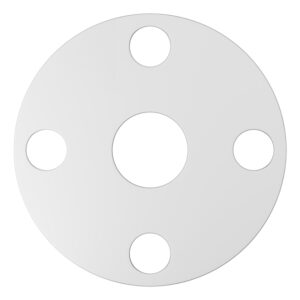
Virgin PTFE gaskets are manufactured from pure, unfilled PTFE resin. They offer the highest level of chemical resistance across virtually all industrial chemicals, acids, and solvents. Virgin PTFE also provides excellent dielectric strength and electrical insulation properties. Because no fillers are added, virgin PTFE is the preferred choice for applications requiring maximum chemical purity, including FDA-regulated food contact and pharmaceutical processing. Durlon® Virgin PTFE is available as sheet stock and custom-cut gaskets.
Filled PTFE Gaskets
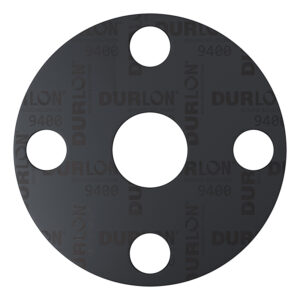
Filled PTFE gaskets incorporate additives such as glass, barium sulfate, or carbon into the PTFE resin to improve mechanical strength, reduce creep, and enhance specific performance characteristics. Glass-filled PTFE (such as Durlon® 9000 and 9000N) provides improved compressive strength while maintaining chemical inertness. Barium sulfate-filled PTFE (Durlon® 9200) is engineered for caustics, hydrogen peroxide, and pulp and paper applications. Carbon-filled PTFE (Durlon® 9400) is designed for aggressive chemical environments, including hydrofluoric acid service. Filled PTFE gaskets are the most common type for general industrial use because they balance chemical resistance with improved mechanical performance.
Expanded PTFE Gaskets (ePTFE)
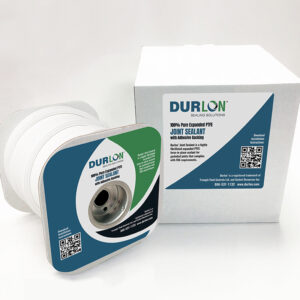
Expanded PTFE (ePTFE) gaskets are produced by stretching virgin PTFE to create a uniform, highly fibrillated microstructure with equal tensile strength in all directions. This process makes ePTFE gaskets highly compressible and conformable, allowing them to seal effectively on rough, damaged, or irregular flange surfaces at lower bolt loads. Unlike filled PTFE, ePTFE maintains the full chemical resistance of virgin PTFE because no additives are introduced. Durlon® 9600 is a biaxially expanded PTFE gasket that does not exhibit the cold flow associated with virgin PTFE or the hardness of some filled PTFE products. Durlon® Joint Sealant is an ePTFE tape used as a cost-effective alternative to cut gaskets on large-diameter or irregular flanges.
How to Select the Right PTFE Gasket
Selecting the appropriate PTFE gasket requires evaluating several application-specific factors. Chemical compatibility between the gasket material and the process media is the primary consideration. For applications involving highly aggressive chemicals where purity is essential, virgin PTFE or ePTFE may be the appropriate choice. For applications requiring higher mechanical strength or reduced creep under sustained load, filled PTFE with the appropriate filler system is typically recommended.
Flange condition also affects selection. Expanded PTFE gaskets conform to rough or damaged flange surfaces more readily than filled or virgin PTFE. Operating temperature and pressure must be matched to the gasket material’s rated limits. Regulatory requirements such as FDA compliance, NSF/ANSI 61 certification, or TA-Luft emissions standards may narrow the selection to specific products.
For application-specific recommendations, Durlon’s engineering team can assess operating conditions and recommend the optimal PTFE gasket type and product. Use the Gasket Application Data Form to submit your service parameters for a technical review.
Industries and Applications
Durlon® PTFE gaskets are used across industries where chemical resistance, purity, and regulatory compliance are required. Key industries include chemical processing, pharmaceutical manufacturing, food and beverage production, water and wastewater treatment, pulp and paper, oil and gas, power generation, marine vessels, and rail tank car applications. Common sealing applications include flanged pipe joints, heat exchangers, pressure vessels, valves, pumps, and process equipment where aggressive chemicals, acids, caustics, or solvents are present.
Certifications and Compliance
Durlon® PTFE gaskets are available with a range of industry certifications and regulatory approvals depending on the product. Certifications across the Durlon PTFE product line include FDA compliance, NSF/ANSI 61, USP Class VI, ABS-PDA, TA-Luft (VDI 2440), DNV-GL, and Chlorine Institute Pamphlet 95 approval. Specific certifications vary by product. For compliance documentation relevant to your application, contact Durlon directly or visit the Product Data Sheets resource page.
Custom PTFE Gasket Solutions
In addition to standard sheet stock and rolls, Durlon® offers custom-cut PTFE gaskets for non-standard flanges, equipment-specific geometries, and unique application requirements. Custom capabilities include die cutting, flash cutting, and lathe cutting in a range of PTFE materials and thicknesses. For details on custom sizing and materials, refer to the Custom Capabilities resource page or submit a Gasket Application Data Form.
Get Reliable PTFE Gaskets for Your Application
Durlon® PTFE gasket sheets provide chemical-resistant, non-contaminating sealing for demanding industrial applications. Choose from virgin, filled, or expanded PTFE gaskets engineered for chemical processing, pharmaceutical, food-grade, and high-purity environments.
PTFE Product Comparison
Virgin PTFE
Construction / Best For: 100% pure PTFE resin; maximum chemical resistance and high dielectric strength; suited to high-purity, food & beverage, and pharmaceutical applications.
Flange Condition: Good, flat flanges
Certifications: FDA compliance for applicable skived grade; RoHS/REACH
Temperature / Max. Pressure: -350°F to 500°F; max. 1,250 psi
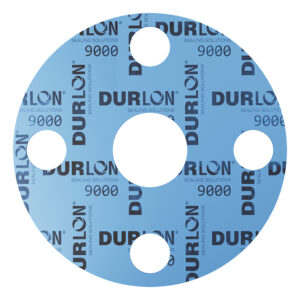
Durlon® 9000 / 9000N
Construction / Best For: Inorganic-filled PTFE; improved mechanical strength and resistance to cold flow; suited to aggressive chemicals, chlorine, caustics, and high-purity applications.
Flange Condition: Good, flat flanges
Certifications: FDA, USP Class VI, and other approvals vary by product
Temperature / Max. Pressure: -350°F to 520°F; 500°F continuous; max. 1,500 psi
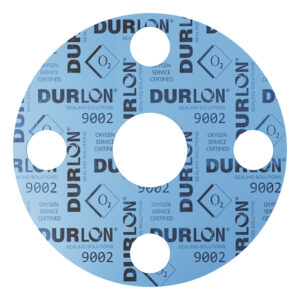
Durlon® 9002
Construction / Best For: Inorganic-filled PTFE developed for extreme cryogenic and oxygen service; available as oxygen-cleaned gaskets.
Flange Condition: Good, flat flanges
Certifications: FDA; BAM Oxygen Service; LOX Mechanical Impact; RoHS/REACH
Temperature / Max. Pressure: -350°F to 520°F; 500°F continuous; max. 1,500 psi
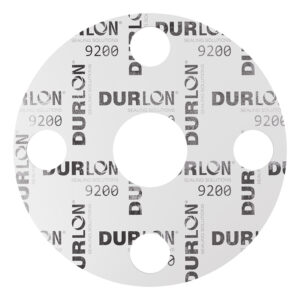
Durlon® 9200
Construction / Best For: Barium sulfate-filled PTFE; suited to caustics, hydrogen peroxide, sodium hypochlorite, and pulp & paper service.
Flange Condition: Good, flat flanges
Certifications: FDA; TA-Luft; BAM Oxygen Service; ABS-PDA and other approvals
Temperature / Max. Pressure: -350°F to 520°F; 500°F continuous; max. 1,500 psi
Durlon® 9400
Construction / Best For: Carbon-filled PTFE designed for aggressive chemicals, including hydrofluoric acid and anhydrous hydrogen fluoride service.
Flange Condition: Good, flat flanges
Certifications: FDA compliant; RoHS/REACH; HFIPI approved material
Temperature / Max. Pressure: -350°F to 550°F; 500°F continuous; max. 1,500 psi
Durlon® 9600 (ePTFE)
Construction / Best For: Biaxially expanded PTFE; highly compressible and conformable for irregular flange surfaces; maintains the chemical resistance of pure PTFE.
Flange Condition: Rough, damaged, or irregular flanges
Certifications: FDA; USP Class VI; ABS-PDA; RoHS/REACH
Temperature / Max. Pressure: -400°F to 600°F; 518°F continuous; max. 2,900 psi
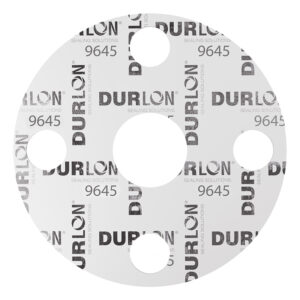
Durlon® 9645 (Microcellular PTFE)
Construction / Best For: Microcellular PTFE with rigid PTFE core; designed for low-torque sealing, irregular surfaces, and applications requiring low leakage.
Flange Condition: Warped, pitted, scratched, or irregular flanges
Certifications: FDA; TA-Luft
Temperature / Max. Pressure: -436°F to 500°F; max. 870 psi
Durlon® Joint Sealant
Construction / Best For: Highly fibrillated expanded PTFE form-in-place sealant; ideal for worn, large-diameter, or irregular flanges.
Flange Condition: Worn, large-diameter, or irregular flanges
Certifications: FDA; RoHS/REACH
Temperature / Max. Pressure: -450°F to 600°F; 500°F continuous; max. 2,900 psi
Contact us today to request a quote or speak with a sealing solutions specialist.
FAQ’s About PTFE Sheet Gaskets
What is the Difference Between Virgin PTFE and Filled PTFE Gaskets?
Virgin PTFE gaskets are made from pure, unfilled PTFE resin and offer the highest chemical resistance and electrical insulation. Filled PTFE gaskets incorporate additives such as glass, barium sulfate, or carbon to improve mechanical strength and reduce creep. Filled PTFE is recommended for higher-pressure applications, while virgin PTFE is preferred where maximum chemical purity is required. See Product Data Sheets for specifications on each Durlon PTFE product.
Are PTFE Gaskets the Same as Teflon® Gaskets?
Yes. Teflon® is a registered trademark (originally owned by DuPont, now Chemours) for polytetrafluoroethylene (PTFE). PTFE gaskets and Teflon gaskets refer to the same base material. Durlon® PTFE gaskets are manufactured from PTFE resins and are available in virgin, filled, and expanded formulations.
Are Durlon® PTFE Gaskets FDA Compliant?
Several Durlon® PTFE gasket products conform to FDA requirements for food contact applications. Products such as Durlon® 9000, 9200, and Virgin PTFE carry FDA compliance. Additional certifications include NSF/ANSI 61, USP Class VI, and ABS-PDA, depending on the product. Contact Durlon for product-specific certification documentation.
What Temperature Range Can PTFE Gaskets Withstand?
Durlon® PTFE gaskets operate across a temperature range of -350°F to 500°F (-212°C to 260°C), depending on the specific product and filler system. Some products, such as Durlon® 9400 (carbon-filled), are rated for continuous service up to 500°F (260°C). See the individual Product Data Sheets for exact temperature and pressure ratings.
What Industries Use PTFE Gaskets?
PTFE gasket sheets are used in chemical processing, pharmaceutical manufacturing, food and beverage production, water and wastewater treatment, pulp and paper, oil and gas, power generation, marine applications, and rail tank car service. Their chemical inertness and non-contaminating properties make them suitable for any application where aggressive chemicals or high-purity requirements are present.