
Proper gasket installation is of utmost importance in industrial machinery to ensure efficient and safe operation. Whether you are working with pumps, compressors, heat exchangers, or other equipment, following the correct gasket installation procedures is critical for maintaining leak-free seals and preventing costly downtime.
A gasket seals fluids and gases, but its effectiveness depends on proper installation. This is crucial for preventing leaks, which can cause efficiency loss, environmental harm, and safety risks.
Correct installation also maintains structural integrity, especially in high-pressure or temperature environments. Improper installation can lead to deformation or failure of equipment. Moreover, it ensures optimal performance and efficiency by distributing stress uniformly and facilitating heat or pressure transfer.
Following manufacturer guidelines extends the gasket and equipment lifespan by preventing degradation. Proper installation reflects precision, attention to detail, and adherence to industry standards in engineering practices, highlighting a commitment to quality and reliability.
View our gasket installation e-book to learn about proper installation, including fundamentals, reference charts, and checklists.

Joint Failure Prevention in Bolted Flange Assemblies
A leaking flange joint is often described as a “gasket failure,” but the gasket is only one part of the bolted flange joint assembly. Reliable sealing depends on the interaction between the gasket, flange faces, fasteners, lubrication, bolt load, and installation practices. When one part of the assembly is incorrect or inconsistent, the joint can lose compression, develop leak paths, or fail prematurely.
Many bolted flange joint failures are preventable when the assembly is reviewed as a complete system. Common contributors include improper gasket compression, uneven bolt loading, incorrect gasket material selection, chemical incompatibility, damaged or mismatched fasteners, flange misalignment, and poor flange surface condition. The attached Durlon Joint Failure Prevention Guide outlines four primary failure categories: installation-related issues, gasket-related issues, fastener-related issues, and flange-related issues.
Common Causes of Joint Failure
Installation-related failures can occur when a gasket is over-compressed, under-compressed, or loaded unevenly. Proper torque, staged tightening, cross-pattern bolt-up, lubrication, and gasket stress control are essential for achieving consistent compression around the flange.
Gasket-related failures are often tied to material selection. Process media, temperature, pressure, concentration, and cyclic operating conditions should all be reviewed before selecting a gasket material. Chemical compatibility must be evaluated across the full gasket construction, including binders, fillers, facings, and reinforcement materials.
Fastener-related failures can reduce or unevenly distribute bolt load. Corroded bolts, mixed bolt grades, incorrect bolt size, thread damage, lack of lubrication, galling, or fasteners not rated for service temperature can all affect joint reliability.
Flange-related failures may result from damaged flange faces, radial scratches, pitting, waviness, poor flatness, or misalignment. These conditions can prevent the gasket from seating properly and create leak paths across the sealing surface.
How to Help Prevent Gasket and Joint Failure
Improving joint reliability starts before the gasket is installed. Maintenance teams should verify the gasket material, inspect flange faces, confirm fastener condition, use calibrated tools, apply the correct torque procedure, and follow recognized installation practices such as ASME PCC-1. Gaskets should never be reused, and any evidence of uneven compression, chemical attack, embrittlement, flange damage, or fastener wear should be reviewed before reassembly.
Download the Durlon Joint Failure Prevention Guide to learn more about common failure modes, visual warning signs, likely causes, and practical prevention steps for bolted flange joint assemblies.
Our Gasket Training Rig
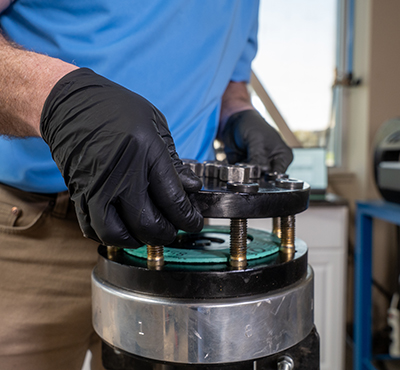
Durlon offers bolt-up and gasket training utilizing a Flange Assembly Demonstration Unit (FADU) based on ASME PCC-1 principles. This 90 minute training incorporates live feedback on the screen as the gasket is simultaneously bolted into place. Participants observe gasket deflection, bolt stress and interaction between bolts (crosstalk), and learn the value of following PCC-1 guidelines and get the opportunity to put their experience to the test.
Who Should Attend
- Pipe fitters
- Maintenance Personnel
- Gasket Fabricators
- Gasket Distributors
- Contractors
- Engineers
- Planners
Agenda
- Learn about bolted flange connections
- Increase gasket life
- Reduce maintenance costs
- Become proactive to fugitive emissions and the environment
- Increase plant pipeline safety and reliability
Training Benefits
- Scattered Bolt Load
- Bolt/Stud Tensile/Yield Strength
- Proper Lubrication
- Legacy/Cross Pattern Bolt-Up
- Use of Washers
- Body Positioning
- Torque/Box Wrenches
- Proper Arm Movement
From beginner to advanced training options. Let us custom fit your needs.
Fill out the form below or CALL NOW to arrange set-up at your location. USA: 1-866-707-7300 or Canada: 1-866-537-1133