
Nov 16, 2026
Selecting the right gasket material is essential to maintaining reliable sealing performance across industrial piping systems and equipment. With varying operating temperatures, pressures, chemical exposures, and flange configurations, gasket materials must be carefully evaluated to meet the demands of each application.
Compressed non-asbestos (CNA) sheet gasket materials are widely used throughout industrial processing environments for their versatility, sealability, and adaptability to a broad range of service conditions.
From general industrial piping to chemical processing, power generation, and food and beverage manufacturing, compressed sheet gaskets provide an effective sealing solution when properly selected and installed.
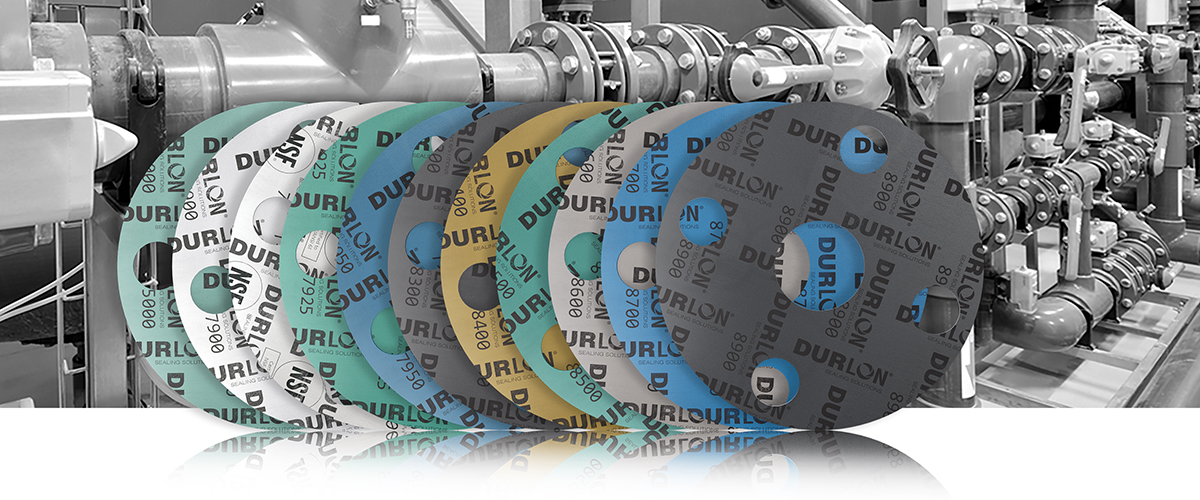
In this Material Spotlight, we explore the composition, performance characteristics, industrial applications, and selection considerations of Durlon® compressed sheet gasket materials.
What Are Compressed Sheet Gasket Materials?
Compressed sheet gaskets, commonly referred to as compressed non-asbestos (CNA) or compressed fiber gaskets, are manufactured using a combination of reinforcing fibers, elastomeric binders, and specialized fillers.
These materials are compressed into dense, uniform sheets designed to provide sealing performance across a range of industrial applications.
Unlike traditional asbestos-based gasket materials, modern CNA sheets use engineered fiber systems to achieve the required mechanical strength, compressibility, recovery, and chemical resistance.
Understanding the Material Composition
The performance of a compressed sheet gasket depends significantly on the materials used in its formulation.
Reinforcing Fibers: Aramid, carbon, phenolic, mineral, and inorganic fibers provide structural strength and contribute to dimensional stability.
Elastomeric Binders: Rubber compounds, including nitrile (NBR), styrene-butadiene (SBR), and chloroprene (CR), bind the reinforcing fibers and influence the gasket’s chemical resistance, flexibility, and temperature performance.
Fillers and Additives: Carefully selected fillers and additives help establish the physical properties required for specific sealing applications.
Different combinations of these components allow compressed sheet materials to be engineered for general industrial service or more demanding operating environments.
Key Performance Characteristics of Compressed Sheet Gaskets
Compressed sheet materials must balance several important mechanical and chemical properties to maintain reliable sealing performance.
Compressibility and Recovery
Compressibility describes a gasket material’s ability to deform under applied load, allowing it to conform to flange surface irregularities.
Recovery refers to the material’s ability to regain a portion of its original thickness after compression.
Together, these characteristics contribute to gasket seating and help maintain sealing contact as operating conditions change.
However, compressibility and recovery values alone do not determine gasket suitability. Available bolt load, flange rigidity, and operating conditions must also be considered.
Chemical Resistance
Industrial gaskets are exposed to a wide range of process media, including water, steam, hydrocarbons, oils, acids, alkalis, and solvents.
The chemical compatibility of a compressed sheet gasket depends on its fiber composition, binder system, and the concentration and temperature of the media.
For example, a material suitable for hydrocarbon service may not provide the same performance when exposed to aggressive chemicals.
Evaluating chemical compatibility is therefore an essential step in gasket material selection.
Temperature and Pressure Resistance
Compressed sheet gasket materials are available in formulations designed for different temperature and pressure requirements.
However, published maximum temperature and pressure values should not be interpreted as simultaneous operating limits.
Actual gasket performance depends on the combined effects of temperature, pressure, media, gasket dimensions, and available assembly stress.
Applications involving thermal cycling or prolonged high-temperature exposure may also require additional evaluation.
Creep Relaxation and Sealability
Creep relaxation refers to the reduction in gasket stress over time under sustained compression.
Excessive gasket stress loss can reduce the contact pressure needed to maintain an effective seal, particularly during thermal or pressure cycling.
Sealability describes a gasket material’s ability to limit leakage under defined testing conditions.
Both properties are important when evaluating the potential for sustained sealing performance in industrial equipment.
How Does Gasket Thickness Affect Sealing Performance?
Gasket thickness is another important consideration when selecting compressed non-asbestos sheet materials. Thicker gaskets can accommodate greater flange irregularities but may also experience increased deformation and stress relaxation under certain conditions.
Thinner gaskets generally offer reduced material volume for creep and extrusion, provided the flange surfaces are sufficiently flat and the available assembly load is adequate.
The appropriate thickness depends on flange condition, surface finish, gasket geometry, operating conditions, and the seating stress required to achieve an effective seal.
Selecting the thinnest gasket suitable for the application can help support sealing performance and long-term joint reliability.
Durlon Compressed Non-Asbestos Gasket Materials
Durlon® offers a comprehensive range of compressed non-asbestos sheet gasket materials engineered to address diverse industrial sealing requirements.
Each grade incorporates specific fiber and binder combinations selected to support performance in its intended applications.
Durlon 8500: Versatile Industrial Sealing
Durlon® 8500 is a high-performance compressed sheet gasket material manufactured using aramid and inorganic fibers bonded with a nitrile rubber binder.
Recognized as Durlon’s workhorse material, 8500 provides excellent sealability, good compressibility and recovery, and reliable performance across a broad range of industrial services.
Typical applications include steam, water, natural gas, oils, new-generation refrigerants, and compatible process fluids.
Durlon® 8500 has also passed the API 6FB Fire Test and conforms to FDA 21 CFR 177.2600, supporting its consideration for applications with specific fire-test or regulatory requirements.
Durlon 8900: Super-heated Steam Service
Durlon® 8900 is a premium compressed non-asbestos gasket material engineered for demanding high-temperature and pressure applications. Designed for saturated and superheated steam, hydrocarbons, oils, and compatible chemical services, Durlon® 8900 incorporates high-strength fibers and graphite fillers with an NBR binder.
The material has also achieved the requirements of the ANSI/API 607, 6th Edition Fire Test, providing an additional performance consideration for applicable industrial sealing systems.
Durlon 8400: Chemical Processing and Steam Service
Durlon® 8400 combines phenolic fibers with an NBR rubber binder to provide high-performance sealing in chemical processing, pulp and paper, and general industrial applications.
With a broad pH application range of 2–13 at room temperature, Durlon® 8400 is suitable for many applications involving steam, mild acids, and caustics.
Chemical concentration, temperature, and pressure must be considered when determining suitability.
Durlon 8600: White Compressed Sheet Material
Durlon® 8600 is manufactured using aramid and inorganic fibers bonded with an SBR rubber binder.
Its white composition makes it a practical option for applications where white gasket materials are preferred, including certain food and beverage, pharmaceutical, and plastics processing environments.
It provides good compressibility, recovery, sealability, and cutting characteristics for compatible industrial services.
Specialized Compressed Sheet Grades
Additional Durlon® CNA materials include:
- Durlon® 7910: NSF/ANSI/CAN 61 certified material developed for specified potable water applications.
- Durlon® 8700: Chloroprene-bonded material offering resistance to ozone, oils, non-aromatic solvents, and many refrigerants.
- Durlon® 5000 and 7900 Series: Commercial and general-service materials for compatible applications under moderate operating conditions.
- Durlon® 8900: An additional compressed sheet option for application-specific requirements.
Durlon Compressed Sheet Gasket Material Comparison
| Product | Material Composition | Primary Application Focus |
|---|---|---|
| Durlon® 8500 | Aramid/inorganic, NBR | General industrial, steam, water, hydrocarbons |
| Durlon® 8300 | Carbon fiber, NBR | Demanding steam and hydrocarbon service |
| Durlon® 8400 | Phenolic fiber, NBR | Chemical processing, steam, mild acids and caustics |
| Durlon® 8600 | Aramid/inorganic, SBR | White gasket applications, food and beverage processing |
| Durlon® 7910 | Aramid, NBR | Specified potable water applications |
| Durlon® 8700 | Aramid/inorganic, CR | Refrigerants, ozone, oils and compatible solvents |
| Durlon® 8900 | Aramid/inorganic with graphite fillers, NBR | High-temperature steam and demanding industrial applications |
Common Industrial Applications for Compressed Sheet Gaskets
The versatility of CNA gasket materials supports their use throughout numerous industrial sectors.
Chemical Processing and Petrochemical
Compressed sheet gaskets are commonly used in flanged piping connections, valves, pumps, and process equipment handling compatible chemicals and hydrocarbons.
Material selection must account for chemical concentration, operating temperature, pressure, and potential process fluctuations.
Power Generation and Pulp & Paper
Steam, condensate, water, and chemical services present varying sealing requirements in power generation and pulp and paper facilities.
Properly selected compressed sheet gaskets can provide reliable sealing in applications where their temperature, pressure, and chemical limitations are respected.
Food & Beverage and Pharmaceutical Processing
Certain compressed sheet materials are suitable for applications requiring documented regulatory compliance.
For example, Durlon® 8500 and 8600 have FDA compliance documentation relevant to specified applications.
Material compatibility, cleaning procedures, sterilization conditions, and applicable regulatory requirements should all be reviewed before selection.
Water and Wastewater Treatment
Compressed sheet gaskets are used throughout water treatment infrastructure, including piping systems, pumps, valves, and processing equipment.
For potable water applications, Durlon® 7910 offers NSF/ANSI/CAN 61 certification within its specified conditions and limitations. Each material should be evaluated using its technical data sheet and applicable certification information.
How to Select the Right Compressed Sheet Gasket
Selecting a gasket material requires more than comparing maximum temperature and pressure ratings. An effective selection process considers the complete application, including:
- Operating Conditions: Continuous and maximum temperatures, system pressures, and thermal or pressure cycling.
- Chemical Compatibility: Process media, concentrations, cleaning chemicals, and potential chemical interactions.
- Flange Configuration: Flange design, surface finish, gasket dimensions, available bolt load, and assembly requirements.
- Material Performance: Compressibility, recovery, creep relaxation, sealability, and chemical resistance.
- Regulatory Requirements: Applicable industry standards, material certifications, and application-specific compliance documentation.
Gasket thickness must also be evaluated in relation to flange condition, sealing requirements, and available seating stress.
Using technical data sheets, gasket factors, and application-specific engineering guidance helps support a more informed material recommendation.
Reliable Sealing Starts with the Right Material
Compressed non-asbestos sheet gasket materials continue to play an important role in industrial fluid sealing by providing versatile, engineered solutions for a broad range of applications.
From general service environments to demanding steam, hydrocarbon, chemical, and water treatment systems, selecting the appropriate material grade is essential to achieving dependable sealing performance.
Durlon® offers a comprehensive portfolio of compressed sheet gasket materials supported by technical data, application guidance, and industry expertise.
Frequently Asked Questions About Compressed Sheet Gaskets
What is the difference between CNA and PTFE gasket materials?
Compressed non-asbestos (CNA) gaskets are manufactured using reinforcing fibers, elastomeric binders, and fillers, while PTFE gasket materials are based on polytetrafluoroethylene. CNA materials provide versatile sealing performance across many industrial applications, whereas PTFE materials are often selected for their broad chemical resistance. Suitability depends on the process media, operating temperature, pressure, and flange conditions.
Can compressed sheet gaskets be used in steam applications?
Yes. Several Durlon® compressed sheet materials are designed for steam service, including Durlon® 8300, 8500, and 8900. The appropriate material depends on operating temperature, pressure, steam conditions, and the mechanical requirements of the flange assembly.
What factors determine the service life of a compressed sheet gasket?
Gasket service life depends on the operating environment, chemical compatibility, temperature and pressure cycling, flange condition, assembly stress, and material properties. Proper selection, installation, and maintenance all contribute to long-term sealing reliability.
Explore Durlon® Compressed Non-Asbestos Sheet Gaskets to compare available grades, review technical specifications, and identify materials suited to your application.
For application-specific recommendations, complete the Durlon® Gasket Application Data Form to connect with our technical team.