
Sep 1, 2026
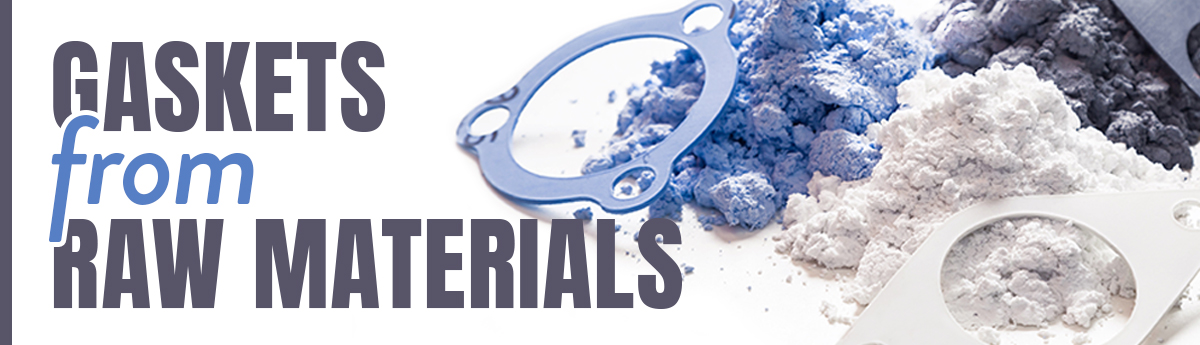
Gaskets are made by selecting a material that matches the service conditions, converting or forming that material into the required gasket construction, and then fabricating it to the required dimensions. The manufacturing method depends on the material and gasket design.
Common examples include:
- CNA, PTFE, and other sheet materials: cut to the required shape using methods such as die cutting, CNC/flash cutting, or waterjet cutting.
- FKM elastomers: formed into a sheet or compression-molded into a finished gasket profile.
- Flexible graphite: expanded and calendared into foil, with optional metal reinforcement.
- Spiral wound gaskets: formed by winding metal and filler materials into the required construction.
A finished gasket can therefore begin as compressed fiber or CNA sheet, PTFE, flexible graphite, an FKM compound, or metallic and semi-metallic components. The manufacturing route determines how that raw material becomes the shape, thickness, reinforcement, and dimensions required for a specific joint.
Material selection and manufacturing must be considered together. Temperature, pressure, process media, cycling, flange geometry, and dimensional requirements all influence both the material and the fabrication method. The sections below explain how gaskets are made from raw materials and how each manufacturing decision affects the finished gasket.
From Raw Material to Finished Gasket
1. Select the Raw Material
The manufacturing process starts with the application requirements. Temperature, pressure, process media, cycling, flange geometry, and required dimensions narrow the material options. For custom parts, drawings, material requirements, tolerances, and production quantities can also influence the manufacturing route.
2. Form or Convert the Material
Once the material is selected, it must be converted into the required gasket construction. CNA, PTFE, graphite, and other sheet materials can be cut using die, CNC/flash, or waterjet methods depending on the material and geometry. PTFE can also be skived into a sheet or lathe-cut from billets.
FKM compounds may be compression-molded into a finished profile or formed into a sheet before being cut. Flexible graphite is expanded and calendared into foil and can be laminated to metal reinforcement. Spiral wound gaskets are produced by winding metal and filler materials into the required construction.
3. Finish and Verify the Gasket
Finishing and verification requirements depend on the application. For custom or critical-service gaskets, this can include dimensional checks, material verification, traceability, and performance testing before the finished gasket is released.
| Starting material or construction | Common manufacturing route | Typical result |
|---|---|---|
| CNA, PTFE, or graphite sheet | Die cutting, CNC/flash cutting, or waterjet cutting | Standard or custom flat gaskets |
| PTFE sheet or billet | Skiving, lathe cutting, CNC/flash cutting, or waterjet cutting | Sheet, ring, or custom PTFE components |
| FKM compound | Compression molding or forming into a sheet and cutting | Molded profiles or flat gaskets |
| Flexible graphite | Expansion, calendaring, and optional metal lamination | Homogeneous or reinforced graphite sheet and gaskets |
| Metal and filler | Spiral winding | Spiral wound gaskets |
Key Factors in Custom Gasket Manufacturing
Custom gasket manufacturing starts with the application and production requirements. The right process depends on several factors:
- Drawings and specifications. Dimensions, tolerances, and material requirements help determine how the gasket should be manufactured.
- Gasket geometry. Non-standard bolt patterns, tight tolerances, and large or irregular shapes can influence whether die cutting, CNC/flash cutting, waterjet cutting, molding, skiving, or winding is the better fit.
- Service conditions. Temperature, pressure, process media, flange condition, and cycling can affect the material, construction, and manufacturing method selected for the application.
- Verification requirements. Custom or critical-service gaskets may require dimensional checks, material verification, traceability, or performance testing before production is complete.
Production quantity can also influence the manufacturing route. Repeat runs of standard shapes may justify dedicated tooling, while custom or lower-volume parts may be better suited to digital cutting or waterjet fabrication.
Durlon’s custom manufacturing capabilities include precision cutting, spiral gasket winding, material verification, laser marking and traceability, leakage and performance testing, and quality control from raw material through finished gasket.
How to Choose the Right Gasket Material for Your Application
Choosing the right gasket material starts with the operating conditions. Temperature, pressure, process media, cycling, flange geometry, and installation requirements help narrow the material options before the manufacturing method is selected.
Service Conditions That Control Gasket Selection
| Selection factor | Why it matters |
|---|---|
| Temperature | Every gasket material and product grade has a defined operating range that should be checked against the service conditions. |
| Pressure and seating load | Pressure and available gasket seating stress influence the required material and gasket construction. |
| Chemical compatibility | The gasket material must be compatible with the actual process media, concentration, and operating conditions. |
| Thermal and mechanical cycling | Applications that cycle repeatedly may require materials with suitable recovery and stability. |
| Flange geometry and condition | Dimensions, surface condition, and flange design can affect material, thickness, and fabrication requirements. |
| Size, quantity, and geometry | Standard parts, high-volume production, and one-off custom shapes can require different cutting or forming methods. |
Match the Manufacturing Method to the Material
Once the service conditions narrow the material options, the manufacturing method should be matched to the selected material, geometry, tolerances, production quantity, and design requirements. Sheet materials can be cut, elastomer compounds can be molded, and metallic or semi-metallic constructions can be wound or fabricated.
Why a Gaskets for Marine Vessels Is Important
Marine service can combine saltwater exposure, persistent humidity, vibration, and thermal cycling. Marine vessel gaskets should be selected for the actual media and operating conditions, while the finished gasket must also match the flange geometry and installation requirements.
Marine sealing applications commonly involve:
- Engine cooling jackets and heat exchanger connections, where the gasket must resist heat cycling combined with seawater cooling flow.
- Pump and valve flanges in ballast, bilge, and fire-main systems, where saltwater contact is constant.
- Hull penetrations and deck fittings, where the gasket manages both sealing and corrosion isolation between dissimilar metals.
Fabricating Marine Gaskets for Non-Standard Flanges
Marine equipment can require vessel-specific gasket dimensions, bolt patterns, and flange shapes. Sheet materials that can be fabricated accurately into non-standard geometries give manufacturers more flexibility to match those requirements while maintaining dimensional consistency.
Applications for a High Temperature Gasket
When service temperatures exceed the limits of conventional elastomer-bonded sheet materials, flexible graphite and other purpose-built high-temperature gasket materials may be considered. Temperature limits are product- and service-specific, so the selected grade should always be checked against current technical data.
How Flexible Graphite Becomes a High Temperature Gasket
Flexible graphite begins as a graphite flake that is expanded and calendared into foil. The foil can remain homogeneous or be laminated to metal reinforcement for additional strength and handling durability. Several Durlon flexible graphite styles are rated to 850°F (454°C) in air. Maximum temperature varies with product construction and service conditions, so confirm the current technical data for the specific material under consideration.
High temperature gaskets are typically specified for:
- Steam systems and boiler connections, where repeated thermal cycling relaxes bolt load over time.
- Furnace, kiln, and reactor access points, where sustained heat exposure would degrade elastomer-bonded materials.
- Process piping in refineries and chemical plants, where high-temperature hydrocarbon or steam service is routine rather than occasional.
Manufacturing consistency is important because thickness, construction, and reinforcement affect how graphite responds under compression. For critical high-temperature service, specify the exact product grade and verify its temperature, pressure, and application data for the intended operating conditions.
Uses of Gasket Sheet Material
Gasket sheet material is a starting form for many industrial gaskets, including CNA, PTFE, and flexible graphite. Depending on the material, size, production quantity, and geometry, sheet stock can be converted using die cutting, CNC/flash cutting, waterjet cutting, or other suitable fabrication methods.
Die cutting can be efficient for repeat production where dedicated tooling makes sense. Digital CNC/flash or waterjet cutting can be useful for custom shapes, lower-volume work, or geometries that do not justify a dedicated die.
Common applications for gasket sheet material include:
- Standard flange gaskets cut to ASME or DIN bolt patterns for process piping.
- Cover plate and manway gaskets, often cut in larger, non-standard sizes.
- Equipment-specific gaskets for pumps, compressors, and heat exchangers where the manufacturer’s original footprint doesn’t match a stock size.
The appropriate sheet thickness depends on the gasket material, flange condition, available seating stress, service conditions, and geometry. For critical or non-standard applications, confirm the thickness against current product data or application engineering guidance.
Benefits of Viton Gasket Material
Viton® is a fluoroelastomer, or FKM, material. Depending on the gasket design, FKM can be compression-molded into a finished profile or formed into a sheet and then cut to shape. The manufacturing route matters because molded parts can incorporate profiles or sealing features that a flat cut gasket cannot.
Viton gasket material can provide several useful characteristics:
- Chemical resistance. FKM is used in many fuel, oil, hydrocarbon, and aggressive chemical services, but compatibility should always be confirmed for the specific media, concentration, temperature, and product grade.
- Temperature capability. Durlon® LT 200 lists a temperature range of -15°F to 400°F (-26°C to 204°C). Because operating limits vary by FKM formulation and gasket design, use the current product data sheet for the selected grade.
- Molded gasket design. Compression molding can produce gasket profiles and sealing features that are not available with a conventional flat cut sheet gasket.
Durlon® LT 200 provides one example of how manufacturing affects the finished gasket. It is precision-molded as a single unit and undergoes a post-curing process designed to improve its compression-set properties.
Why Use a Graphite Gasket Sheet
Flexible graphite gasket sheets begin with a natural graphite flake that is expanded and then compressed and calendared into a continuous sheet or foil. Depending on the design, the material can remain homogeneous or be laminated to stainless-steel foil or tang reinforcement for additional strength and handling durability.
Graphite gasket sheets are commonly selected for characteristics such as:
- broad temperature capability, depending on the specific grade and service;
- conformability and recovery during thermal cycling;
- chemical resistance for suitable media; and
- the availability of reinforced constructions for more demanding applications.
Chemical compatibility and operating limits should always be confirmed for the particular graphite grade and process conditions.
When Metal Reinforcement Is Used
Durlon offers flexible graphite constructions in homogeneous and laminated styles with different core materials. Reinforcement can improve mechanical strength and handleability for larger or more demanding gasket designs.
Graphite grade, reinforcement, thickness, and operating conditions should be evaluated together. Check the current product data for temperature, pressure, compressibility, recovery, construction, and other application-specific performance requirements.
Frequently Asked Questions About How Gaskets Are Made
How Are Gaskets Made from Raw Materials?
Industrial gaskets follow different manufacturing routes depending on their material and construction. Flat sheet gaskets are cut to the required geometry, elastomer gaskets can be molded into a finished profile, flexible graphite is expanded and calendared before cutting or reinforcement, and spiral wound gaskets are formed by winding metal and filler materials together. The service conditions and gasket design determine which manufacturing route is appropriate.
What Raw Materials Are Commonly Used to Make Industrial Gaskets?
Common gasket materials include compressed fiber or CNA sheet, PTFE, flexible graphite, elastomers such as FKM, and metallic or semi-metallic materials. The appropriate starting material depends on chemical compatibility, temperature, pressure, flange design, cycling, and other service requirements.
How Are Gaskets Cut from Gasket Sheet Material?
Sheet gasket materials can be converted using methods such as die cutting, CNC or flash cutting, waterjet cutting, and other precision fabrication processes. The appropriate method depends on the material, gasket dimensions, tolerances, production quantity, and whether the shape is standard or custom.
What Is the Difference Between Cutting and Molding a Gasket?
Cutting starts with a finished sheet material and removes material to create the required gasket geometry. It is commonly used for flat gaskets made from CNA, PTFE, graphite, and similar sheet materials. Molding starts with an uncured or formable compound and shapes it under controlled conditions into the final profile. Molding is useful when the gasket needs features such as ribs, beads, or a three-dimensional profile that cannot be produced by cutting a flat sheet.
How Do You Choose the Right Gasket Manufacturing Method?
The manufacturing method should match both the material and the application. Consider the process media, temperature, pressure, flange design, gasket dimensions, tolerances, production quantity, and required construction. For custom applications, drawings and application data can help determine whether cutting, molding, winding, skiving, or another fabrication method is appropriate.
Why the Gasket Manufacturing Process Matters
Gasket performance depends on how the material, construction, dimensions, and manufacturing method come together for the intended service. Whether the gasket is cut, molded, reinforced, or wound, the manufacturing route should match the application’s operating and dimensional requirements.
Need a custom gasket? Contact Durlon to review your requirements and discuss the material, construction, and manufacturing method that best fit your application.